
|
|
||||||||||||||||||


| 2026-2027 Electoral Calendar, latest official version |

|
 |
|
|
|
|
|
|
|||||||
|
|
Haiti - Politic : Advocacy for the Reform of Maternity Health Insurance 13/01/2025 05:47:11
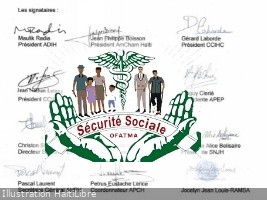
A dozen employers’ and civil society organizations are advocating for reform of Haiti’s health laws to ensure that all Haitians have access to adequate health insurance. "Under the Organic Law of the Office of Work Accident, Sickness and Maternity Insurance (OFATMA), published on October 28, 1967, all employers in Haiti are required to provide their employees with health/maternity insurance, with costs shared between employers and employees. When it was created, OFATMA intended to offer this type of insurance, but for 47 years, it failed to fulfill this role. It was only about ten years ago that OFATMA began offering health/maternity insurance. Letters were sent to all employers in the formal sector, insisting that they were required to purchase health insurance from OFATMA. In September 2015, a meeting was held between the Employers’ Associations and the Director General (DG) of OFATMA. Many companies were able to demonstrate that they had already been providing health insurance to their employees through private insurers for years. During the meeting, the DG of OFATMA granted these companies permission to continue using their existing insurance providers, with a request for additional negotiations. However, these negotiations never materialized. Currently, patients insured by OFATMA can theoretically receive services from private healthcare providers, but in reality, most hospitals, clinics and pharmacies do not accept OFATMA insurance. The main reason is that OFATMA continues to have many payment delays, sometimes taking more than a year to settle claims, and that reimbursements do not cover the full cost of treatment, as the benefit schedule is outdated and does not reflect the reality of costs. Although OFATMA operates four hospitals in four departments of the country, including Port-au-Prince, which is in a lawless zone, there are over 100 private hospitals and several hundred clinics and pharmacies that remain inaccessible to OFATMA patients. Private insurance companies have much better relations with private health care providers, and almost all hospitals and clinics accept private insurance without problems. The signatories believe that health care is a fundamental right for all workers, and that workers should have the freedom to choose the institution where they receive their care. No international law requires that only the government can provide mandatory health insurance. In fact, in at least seven Latin American countries - Chile, Argentina, Uruguay, Brazil, Colombia, Ecuador, and the Dominican Republic - workers have a choice. Haiti’s health laws need to be reformed to allow workers to choose their health care providers and for private providers to participate in health/maternity insurance programs. While there are many details to work out, the signatories believe that such reform is necessary to ensure that all Haitians have access to adequate health insurance, whether through: • Premiums paid by employers and employees in the formal sector; • Subsidized premiums for workers in the informal sector; • Non-contributory insurance for the most vulnerable citizens. Our ultimate goal should be universal coverage. We would like to have a dialogue with labor leaders, civil society leaders, and the Government of Haiti to find consensus.
Maulik Radia, President ADIH - Jean Philippe Boisson, President AmCham Haiti - Gérard Laborde, President CCIHC, Jean Nathan Letanh, President CCIH - Rosny Desroches, Executive Director ISC - Maguy Clerié, President APEP - Christon St Fort, Executive Director FEPH - Caroline Hudicourt, Executive Director COSPE - Me Marie Alice Belisaire, President SNJH - Pascal Laurent, Secretary General AHPH - Petrus Eustache, Coordinator APCH and Jocelyn Jean Louis, RAMSA HL/ HaitiLibre
|
|










|
|
Why HaitiLibre ? |
Contact us |
Français
Copyright © 2010 - 2026 Haitilibre.com |