
|
|
||||||||||||||||||


| 2026-2027 Electoral Calendar, latest official version |

|
 |
|
|
|
|
|
|
|||||
|
|
Day of discussions with Catholic leaders on the accreditation of Haiti's educational institutions 28/06/2026 09:54:53 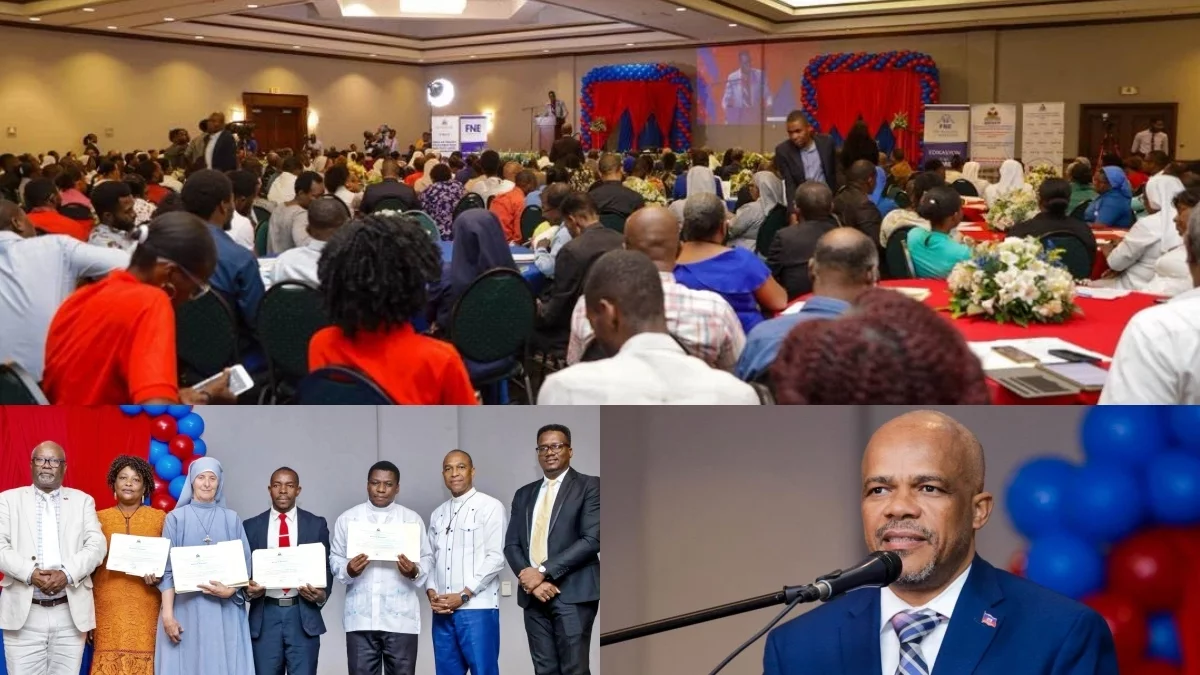
Following a meeting with Protestant leaders on June 10 (https://www.haitilibre.com/en/news-47736-haiti-education-day-of-discussions-with-protestant-leaders-on-the-accreditation-of-educational-institutions.html), the Ministry of National Education (MENFP) organized a second meeting on June 24 in Pétion-ville, focusing on the National Policy for the Accreditation of Private Schools, Technical Training Centers, and Private Universities. The dialogue was open to representatives of training institutions within the Episcopal Commission for Catholic Education (CEEC). "It is an honor and a republican duty to welcome you today," declared Minister Vijonet Déméro at the outset. "The Catholic Church represents a large part of the structure of our educational system, with the establishment of institutions of excellence even in the most remote rural areas," stated Minister Dr. Vijonet Déméro, who expressed his deep gratitude to the Church for the role it plays in the transmission of knowledge in the country. For Déméro, if the Catholic sector succeeds in its modernization, Haitian schools will be transformed. If it commits to change, the Republic will move forward. The Minister took the opportunity to outline some of his administration's major projects: curriculum reform, the single textbook, digital education, civic education, financial literacy, mental health and student well-being, the opening of additional public schools, the construction of school buildings, and the expansion of the National School Canteen Program (PNCS). Also speaking at the event's opening ceremony, Bishop Pierre André Dumas, President of the Episcopal Commission for Catholic Education (CEEC), stated his belief that education remains a powerful tool for social transformation and liberation; it fosters a critical awareness essential for discernment and social action. This, Bishop Dumas added, is why the accreditation of educational institutions is important, as it contributes to strengthening and improving the quality of the education system. During the second part of this activity, Walex Pierre, Director of the Directorate for Support to Private Education and Partnerships (DAEPP), presented the main points of the National Policy for the Accreditation of Private Schools (PONAEP). Franck Lauture, Director General of the National Institute for Vocational Training (INFP), and Jean Judson Joseph of the National Agency for Higher Education and Scientific Research (ANESRS) detailed the procedures for the recognition of vocational schools and private universities, respectively. Following this, Elysé Colagène, Director General of the National Education Fund (FNE), presented the school subsidy procedure, while Ulrick Edouard, Director of Programming and Monitoring at the National School Canteen Program (PNCS), outlined the steps a school must follow to join the program. At the end of this day of discussions, Osny Jean Marie, the Director General of the Ministry, presented operating and management permits to the heads of a sample of schools in the West Departmental Directorate of Education (DDEO). HL/ HaitiLibre
|
|








|
|
Why HaitiLibre ? |
Contact us |
Français
Copyright © 2010 - 2026 Haitilibre.com |